News Story
Fate carried Béla Bartók from ethnomusicological research in Hungary to wartime exile in the US. Three performances in the 2026 Edinburgh International Festival feature Bartók's music from different points in his life.
Hear NYO-USA perform Bartók's Concerto for Orchestra on Mon 10 Aug 2026, 7.30pm at Usher Hall.
Hear Vilde Frang perform Bartók's Violin Sonata No. 1 on Sat 22 Aug 2026, 11.00am at The Queen's Hall.
Hear Kleio Quartet and Makoto Ozone perform Bartók's Piano Quintet in C on Wed 19 Aug 2026, 11.00am at The Queen's Hall.
Read more about Béla Bartók's life ⬇️

Written by Jessica Duchen.
Jessica Duchen contributes to The Times, The i Paper and BBC Music Magazine. Her librettos include Roxanna Panufnik’s award-winning opera Dalia for Garsington 2022. Her latest book is the biography Myra Hess: National Treasure.
Read time: 3-4 minutes
Béla Bartók: A Brief History
Outside South Kensington underground station in London stands a bronze statue of the composer Béla Bartók. He is shown as a diminutive man in overcoat and hat. His impact on the musical world, though, proved him a giant.
Fate carried him from ethnomusicological research in Hungary to wartime exile in the US. Artistically, too, he travelled many long miles – from his first major success, the tone poem Kossuth, a step away from Richard Strauss, to later works that bear the impacts of Stravinsky, Debussy and occasionally serialism, yet build a language entirely his own.
Bartók first made his name as a pianist, writing much of his piano music to perform himself. From Pressburg, where he and his mother had lived since his father’s early death, he had gone to Budapest to study with a pupil of Liszt, István Thomán. Still, Bartók considered himself as much an ethnomusicological researcher as a composer and performer.
His Piano Quintet in C major (1903) seems to spring from a Hungary that Brahms and Liszt just missed. Drawing on the distinctive rhythms, tension and high energy of Hungarian folkdances, it represents a fascinating meld of worlds.

Statue at South Kensington Béla Bartók
© WikicommsInspiration at Home and Away
From 1908 Bartók and his colleague Zoltán Kodály made regular field trips to rural areas, seeking peasant communities where someone might sing them traditional songs. The composers recorded these on an Edison phonograph, then transcribed them; their collection finally numbered more than 10,000. Bartók in 1913 undertook similar research in Algeria and in 1936 Turkey. He created numerous concert versions of folksongs for varied forces such as solo singer with piano, or choir, or instrumental pieces – a near-ideal synthesis of folk and art music.
Other inspirations were more personal. In an intriguing pattern, he fell intensely in love with star violinists, then married young piano students soon afterwards. The violinist Stefi Geyer inspired his Violin Concerto No. 1, though never performed it. Bartók became infatuated with her when she was 17 in 1907, only to be rejected. In November 1909 he married Márta Ziegler, who was 16 at the time.
World War I and the 1920 Treaty of Trianon left Bartók despondent. The Treaty excised so much of Hungary’s territory that the places where he was born and raised were no longer part of his homeland. The first, Nagyszentmiklós, was ceded to Romania; Pressburg became Bratislava, now in Slovakia. In these years he composed little beyond folksong arrangements.

Bartok recording folk music
© WikicommsResurgence and Maturity
In autumn 1921, however, he began work on the Violin Sonata No. 1, intended for the violinist Jelly d’Arányi and, at the piano, himself – as attested by its fearsomely complex piano part. A bedazzlement with d’Arányi, an artist as charismatic as she was musically adventurous, followed when they toured the sonata to Paris. D’Arányi, however, did not return his feelings any more than Geyer had. In 1923 Bartók and Marta divorced. Two months later he married Ditta Pásztory, 19 to his 42.
D’Arányi did, however, invite him to London. He became a frequent visitor to the city through the 1920s-30s and befriended British composers who were researching folk music, including Warlock and Delius. His music developed in these interwar years through such compositions as The Miraculous Mandarin, many of his string quartets and the first two piano concertos.
The rise of the Nazis, however, and the allying of Hungary to Hitler horrified him. He was even annoyed that the Nazis’ 1937 ‘Entartete Musik’ (‘degenerate music’) exhibition had not included him in its music section. His attitudes left him open to political attack in Hungary and the situation deteriorated until a 1940 US tour gave him the chance to explore the potential for emigration. Later that year he and Ditta left Hungary for New York.

Bartok & Pasztory
© WikicommsA New Start in the States
The American Dream, however, did not at first appear to include a means to make a living in music. A research fellowship at Columbia University, working on a collection of Serbo-Croatian folksongs, was some support in an otherwise precarious existence. Worse, he was experiencing the first signs of leukaemia.
A commission from the conductor Serge Koussevitzky turned the tide, paying Bartók $1000 for a large-scale composition for the Boston Symphony Orchestra. Spending summer 1943 at rural Saranac Lake gave him peace to write; the result was the Concerto for Orchestra, in which every player is treated as a virtuoso participant. Its five movements span emotional spheres from the dark dread of the opening to the earthy grace of the ‘game of couples’, a moment that pokes fun at Shostakovich’s Symphony No. 7, and an exhilarating finale. Premiered on 1 December 1944, it enjoyed immediate success, the Boston Herald describing it as ‘the composer’s masterpiece’.
Despite his illness, Bartók finally experienced a creative renaissance, producing the Sonata for Solo Violin for Yehudi Menuhin, the Piano Concerto No. 3 and the Viola Concerto. Tragically, leukemia caught up with him all too soon, and the two last concertos were not quite complete upon his death in September 1945. He told his doctor: ‘My greatest regret is that I am leaving with a full trunk.’
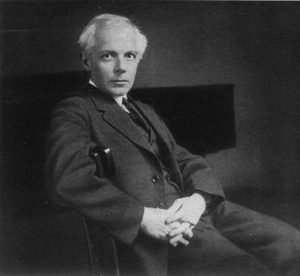
Bartok Bela 1927
© WikicommsExperience the music of Bartók at Edinburgh International Festival
NYO-USA perform Bartók's Concerto for Orchestra on Mon 10 Aug 2026, 7.30pm.
Kleio Quartet and Makoto Ozone perform Bartók's Piano Quintet in C on Wed 19 Aug 2026, 11.00am.
Vilde Frang and Friends perform Bartók's Violin Sonata No. 1 on Sat 22 Aug 2026, 11.00am.