News Story
Two Indigenous poets. Two composers. This is the story how the first half of Voices of Canada came together, where Indigenous artists and voices take centre stage.
Orchestre Symphonique de Montréal's Head of Programming, Ronald Vermeulen, shines a light on the creative journeys behind the music, from a mourning song for lost children to a celebration of Indigenous women's resilience ⬇️
Orchestre Symphonique de Montréal perform Voices of Canada at Usher Hall on Thu 20 Aug 2026, 7.30pm.

Written by Ronald Vermeulen, Orchestre Symphonique de Montréal's Head of Programming
Read time: 2-3 minutes
People tell stories. They are essential for our existence. Stories record our daily lives, they recount shared experiences, they give comfort and provide powerful warnings. Stories connect us to the past and to distant places. They keep our shared history alive.
For this concert, we wanted to create a first half that would showcase stories deeply rooted in Canada’s existence. And this is how an extraordinary group of artists came together. The two works we present in the first part of tonight’s concert, were written by their respective composers in close collaboration with the poets and the singers of their choice.
Ana Sokolovic met the Mi’kmaq artist Michelle Sylliboy several years ago. This encounter marked her profoundly, as she writes: “In her I found a wounded yet strong woman who was open to dialogue."
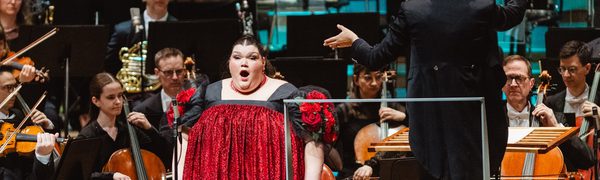
Elisabeth St Gelais
© Gabriel FournierI was thrilled – and somewhat daunted – by the prospect of setting music to a Mi’kmaq text. Michelle went on to write a breathtaking poem inspired by the tragic discovery of the remains of Indigenous children who were taken from their families to attend residential schools in Canada, never to return.Ana Sokolovic
“Michelle’s poem served as the starting point for every aspect of my composition: both the musical and the semantic dimensions. I wanted to do justice to the Mi’kmaq language, which is melodically fluid, rhythmically complex, and full of unexpected accentuations in its melodic contours.
“Without being silenced by rancor, the text harbors a tremendous spiritual force. In Mi’kmaq culture, death is seen as a continuation of life, but in order for life to continue after death, a proper burial is required. Having been robbed of these traditional burial rites, Michelle’s text enacts the mourning process through its tenderness, and offers hope that these children may proceed, in peace, to leave the Earth and embark on this ‘continuation of life’.”
“Listen to us, do not ignore us”, pleads Sylliboy.
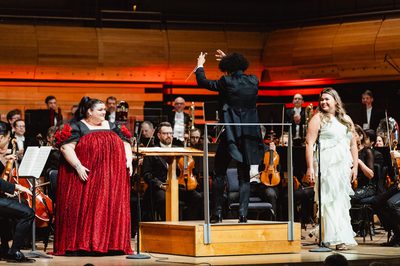
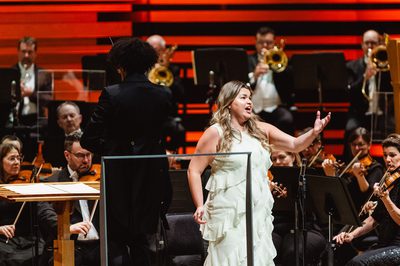
Emma Pennell & Elisabeth St Gelais
© Gabriel FournierIn stark contrast stands Ian Cusson’s setting of Natasha Kanapé-Fontaine’s poem: Un cri s’élève en moi, which speaks about birth, the flourishing and the power and resilience of Indigenous women. Cusson describes his work as a celebration of the power of women: “the backbones and sustainers of all communities”.
He writes that “the work opens with the sound of the universe shivering under the feet of the woman. The world waits in expectation for her return—standing, powerful, resurgent. The sound of the planets ushers in her statement: ‘I am the poem of existence’. This starts the cycle of birth, and new life where she acknowledges the things she has seen and experienced: wounds, the shock of dispossession, the weight of pain. But it is also in this existence that she finds her voice, the power to say ‘yes.’ To force open the doors of silence.
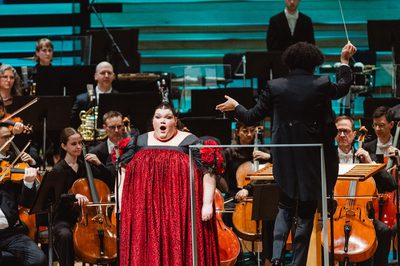
Emma Pennell
© Gabriel FournierTo give life back to the shadows, to the broken children, to those who no longer know how to speak the words. She makes her ultimate declaration: ‘I am cannibal priestess. Eater of horizons’. She is the beginning and the summation of all things. She is the memory of communities. She will never forget.”
Maybe the most startling words in this poem are: “The poem enters me like a lover. The universe enters my body to continue the movement of the lifecycle. Everything is circle. The land. The blueberries and the apricots. The poem is the movement that fertilizes.”
Tonight’s program will be a dialogue between cultures in text and music over times and space, adding to the infinite story of humanity, as Natasha Kanapé-Fontaine writes: “I am the poem of existence […] I remember …”
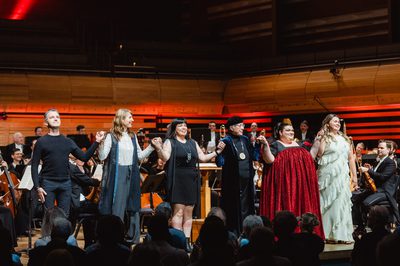
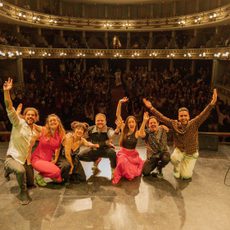
1) Ian Cusson, composer of Un cri s'élève en moi; 2) Ana Sokolović, composer of You can die properly now; 3)Natasha Kanapé Fontaine, author of Un cri s'élève en moi; 4)Michelle Sylliboy, author of You can die properly now; 5) Emma Pennell, Soprano; 6) Elisabeth St-Gelais, Soprano
© Gabriel Fournier