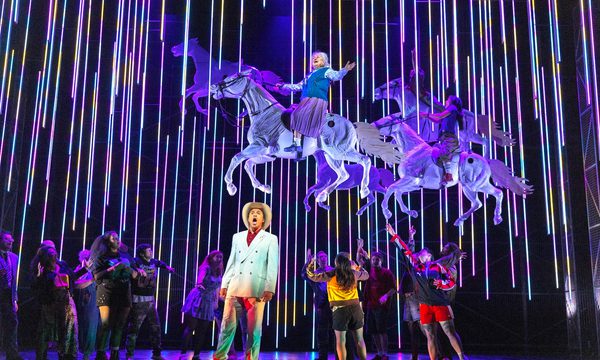
News Story
Few contemporary playwrights have shaped the cultural and political imagination of America as profoundly as Tony Kushner. Across a career spanning more than four decades his work has explored the huge forces that shape individual lives: politics, history, identity, power, faith and desire.
Yet he remains best-known for Angels in America, his theatrical two-part epic set against the AIDS crisis of the 1980s. Premiering in the early 1990s, the work rapidly came to be regarded as one of the defining plays of the late twentieth century. In this 2025 interview, Kushner reflects on the impact of first seeing Director Ivo van Hove’s pared-back revival of Angels in America at International Theatre Amsterdam.
Angels in America makes its UK Premiere at Edinburgh International Festival on Sat 15 – Thu 20 Aug at The King's Theatre.

The following interview of Tony Kushner by Joris Henquet was originally published in de Volkskrant on 10 April 2025 and is reproduced with permission.
Read time 7-8 minutes
Mr. Kushner, in the past you have praised the version of Angels in America that Ivo van Hove created. What do you remember about the first time you saw this production?
I remember flying to Amsterdam in a very bad mood. It was 2008. I was in the middle of writing the screenplay for Lincoln, the film Steven Spielberg and I were working on. Just before my departure, Steven called me to say that Daniel Day-Lewis, our first choice for Lincoln, was unavailable and that we probably wouldn't be able to make the film because of it. So, upon arriving in Amsterdam, I was in a state of despair, because I had put so much of myself into this screenplay; I had worked on it for five years. That was going up in smoke.
So I dragged myself to the theatre in Amsterdam, but half an hour into the play, my mood changed. I began to get very excited by what I saw, and by the end of the performance, I felt kind of euphoric. It felt like a resurrection to me, and I am still grateful to Toneelgroep Amsterdam for that.
Their production was so minimalist; for a production by Ivo, very little technology was used; you see only that empty black space and a few props. But they had made such a brilliant reading of the play; such a profound engagement had been made.
It showed me how you can create something very powerful with very little. Unlike making a film, which involves so much money, staff, and complex technology. But here I saw only eight actors at work, playing with a minimum of technological means, and because of that, they were revealing the play over and over again. There's moments that were revelations to me.
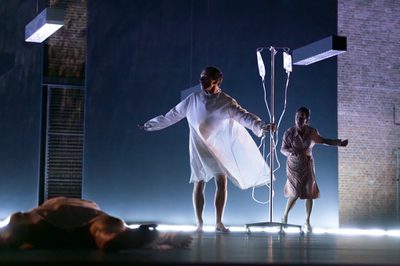
Which moments from the production have stayed with you the most?
The moment when the angel appears, at the end of Millennium Approaches. In the play, that is a woman with wings who breaks through the ceiling. But at Toneelgroep Amsterdam, it is an actor in a nurse's costume who simply walks on stage. He takes Prior by the hand and starts spinning him around, in a playful manner, but the spinning gets faster and faster until Prior falls on his butt.
At first I thought: What the hell is this? But the longer it goes on, the more empathy you start to feel – until you feel pain in your own rear end too. It becomes something ineluctable. By the end of that scene, I was crying.
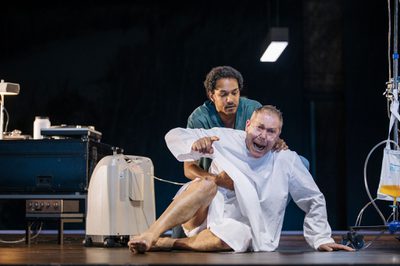
Angels in America
© Fabian CalisHow was it for you to see that Ivo van Hove had cut large segments out of your script?
I don't think I am very strict about staging my plays. I mean, you can't just do whatever you want with Angels in America. But the longer the play exists and the more often it has been performed, the less I worry about directorial choices. In Ivo van Hove's staging, all sorts of parts have been removed and there is a different ending. I wouldn't say that this is exactly the piece I wrote, but at its core, it is entirely in line with it. I see it as Ivo van Hove's version of Angels in America, in the same way that Mike Nichols HBO-miniseries is Mike Nichols' version of Angels in America.
With Ivo, there was something else at play. Before 2008, I had already seen many of his productions in New York, such as Alice in Bed, the play by Susan Sontag, and his versions of A Streetcar Named Desire and Hedda Gabler. When he approached me asking if he could direct Angels in Amsterdam and be allowed to make adjustments to the text, I thought: this is one of the best directors I know, so do with it whatever you want. I gave him carte blanche. That turned out well.
I don't understand Dutch, but it came across as a coherent dramatic thing. It is just very dark with Van Hove, and I believe I am a fairly optimistic person. Although I don't want to be stupidly optimistic. But I believe in my task as a writer – even when dealing with something as terrifying as the AIDS crisis – to look for plausible moments for hope, for the possibility of transformation and change.
With Ivo, death has the last word. He has left out the original epilogue. As a result, this version is quite different from other stagings. I find it an astonishing theatrical event.

The play explicitly focuses on the years that Ronald Reagan was president. Do you think the play takes on a different meaning in every political era?
I have seen the play change in various ways. When it was first performed in New York and London in the early nineties, people had just started to learn to live with AIDS. The devastating impact of the epidemic was over, but it was still fresh in everyone’s memory. The play was a kind of ritual space for people to mourn the decade we had just been through.
When Bill Clinton became president in 1993, we thought – very naively – that this was the end of a nightmarish time of political regression. Apart from the entertainment value the play also has, it was a kind of announcement of the progress we had made with LGBTI emancipation.
Since then, it has been performed in countless countries all over the world, and it is still being staged. The actors who play the characters of around 30 years old now did not experience the AIDS epidemic themselves. That makes it a very different experience. Roy Cohn is a man from the past, and the McCarthy era is a vague memory altogether.
Do you see parallels between the Reagan years and those of Trump?
It is the continuum of the Republican Party. You can even draw a line all the way back to the years just before and just after World War II. The Republican project has always been anti-democratic. I am currently working on a film adaptation of the book Prequel by journalist Rachel Maddow. In her research, she draws connections between fascism in America during the Hitler years, which transitions into McCarthyism (when alleged communists were persecuted in the 1950s, ed.) and then into anti-communism. And so on.
You see that each eruption of American conservatism has paved the way for where we have ended up now. President Richard Nixon introduced the Southern Strategy, whereby you could regain power by appealing to the racists in the southern states. That is how he won the elections in 1968. And then, upon taking office in 1981, Ronald Reagan came out with his famous statement: ‘Government is never the solution, it's the problem.
This involves a form of ego-anarchism; the character Louis also talks about it in Angels in America. For forty years since then, it has been beaten into the head of the American people: the notion that the government is evil. The Reaganites paved the way for Trump.
But what did they actually think? The government is democracy. The government is the people. You cannot separate them. If you attack the idea of government, you automatically attack the idea of democracy. What is left then, except anarchy? You pave the way for fascism. So yes, it is a terrible time we are living in.
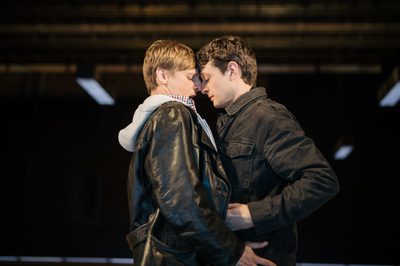
Which themes from Angels in America do you think will come to the surface particularly in our current moment?
One of the paradoxes of Angels in America is that it is set in the years when Reagan was telling everyone that selfishness and individualism were the highest good. You had to look after yourself above all else. Government and the collective experience were seen as a pernicious ideology, imported from the Soviet Union.
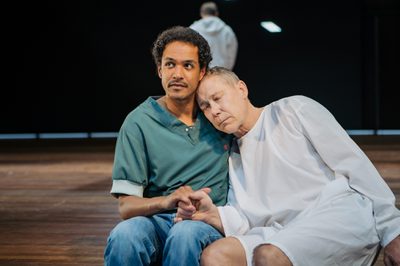
And precisely at that time, the AIDS epidemic struck, and a generation of young people – especially young men my age at the time – were forced into the role of caregiver for terminally ill friends and lovers. That was a very non-traditional and unnatural role, but it was amazing to see how the gay community struggled with it at first, but then actually did it.
I think that is where the storyline surrounding the characters of Louis and Prior came from. I wondered: what if a man fails to care for his sick friend? What if he fails at it? What if it takes seven and a half hours to show this struggle on stage?