News Story
A group of hearing and Deaf actors explores unknown terrain in Chekhov's The Seagull, one of the greatest plays in the history of literature.
Read more about Toneelhuis's production of [seagull] ⬇️
Written by Scarlet Tummers, Dramaturg
Originally published in Dutch by Toneelhuis. Translated by Lola Gaztañaga Baggen and republished with their permission.
Read time: 3-4 minutes
The Seagull (1896) by Anton Chekhov is one of the greatest and tenderest plays in the history of literature. It’s a play about the desire to break open the old, the existing, to make way for the new, the as-yet-unknown – both in love, and in art. ‘We need new forms. New forms are what we need, and if we can't have them, then we’d better have nothing,’ says Konstantin, son of the lauded actress Arkadina. Olympique Dramatique scales the story down to four pairs across three generations: searching for love, for artistic expression, for the very right to exist.
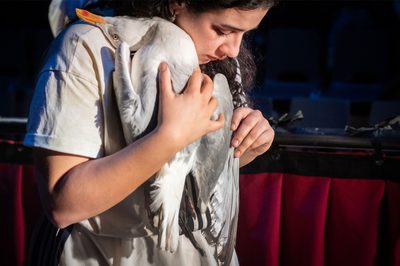
When I saw a rehearsal, I was amazed at the way a classic such as this can be rendered new. In all The Seagulls I had seen up to that point, I’d mostly noticed the great, famous writer Trigorin; the man who, through his prestige and talent, defines and determines the framework of desire for all of the characters around him. Now, I suddenly saw four women in the centre, fighting against their position within the patriarchy.
The labels that once defined them are gone: Arkadina is no longer the bad, selfish mother who doesn’t want to take care of her child. Nina is no longer simply foolish and naïve. Masha is not an enormously passive marginal figure with a drinking problem. Polina is no longer merely old, and therefore irrelevant and unattractive. I saw four women full of fight, who do not allow themselves to be typecast and who believe themselves to be, just like the men in the play, deserving of happiness.
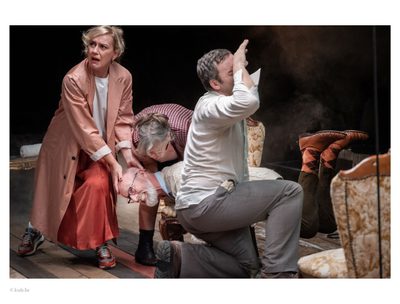
Konstantin wants to become a playwright and represents in [seagull] the youngest generation that both needs and wants to relate to the generation that his mother Arkadina and her lover Trigorin belong to. Konstantin rebels against this. In contrast, Nina, a young woman who dreams of being an actress and who Konstantin is in love with, is drawn to what the older generation possesses. In this [seagull] a Deaf and a hearing actor play these iconic roles; both of them at the beginning of their lives, within and beyond the theatre.
In this way, the search for new theatrical forms also represents something larger: how can we maintain a dialogue with one another in a world that is so strongly polarised and in which people outside of our bubble are becoming increasingly harder to reach?
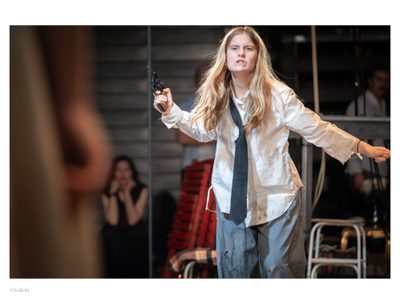
Masha and Medvedenko are in their thirties. Masha is at a turning point in her life: does she choose a marriage that is only half happy? Does she choose to have a child? We watch a woman that needs to start shaping her identity through her roles as partner and mother – and who is miserably unhappy. She describes herself as: ‘brave enough to try to be brave.’ ‘I think you can become anything, so long as you can muster the courage to be courageous,’ Trigorin later tells Nina, making Masha's words his own.
Arkadina and Trigorin embody the established order. Trigorin is a man who is attributed power by those around him – power he neither can nor wants to deal with. He’d rather fish. Arkadina is a woman who needs to reposition herself now that she is no longer up-and-coming. Who needs to step aside to make room but is still bursting with energy and clings to her inner youthfulness. A woman who is confronted by her lover's infatuation with someone twenty years younger. Passionately, she tries to put the depth of her relationship with Trigorin into words.
And then there is Polina, a woman searching for a way of growing old, of saying goodbye to life and to possessions. She desperately wants to share this with Dorn, but male interest in an older woman remains absent.
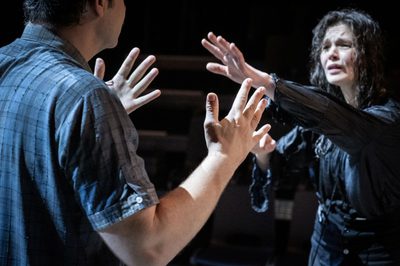
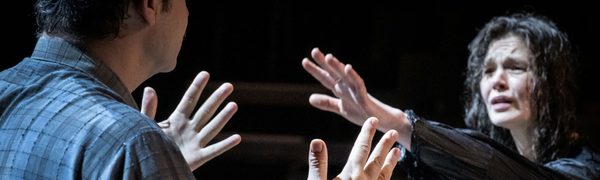
‘A comedy in four parts’, the subtitle of The Seagull decrees – this is Chekhov giving us a pointer. He places his characters in a field without a dominant figure to steer them. He uses a musical storytelling structure with an indirect way of composing. Not a lot happens, and what does happen, happens off stage. Talking becomes the direct externalisation of human thought, allowing us, the audience, space for reflection. In this staging, this externalisation becomes even more physical through sign language.
Even though the circumstances are dramatic – unrequited love, an unhappy marriage, a dead child, suicide – Chekhov’s indirect storytelling still allows room for lightness. Space to see these events in a light different from the one we already know and are familiar with. To see nuance. The humane. To step beyond the cliché of our category-driven thinking – young, therefore naïve; old, so possessing wisdom in spades.
This group of hearing and Deaf actors explores unknown terrain. An attempt at a conversation that might just expose our inability to stay open-minded in the face of differences, but which nonetheless challenges us to look that inability in the eye.