News Story
Beneath the champagne and elegance of Verdi's A Masked Ball lies a murder in slow motion. Conductor Gianandrea Noseda explains how Verdi built tension into every bar of the score.
A Masked Ball makes its UK Production Premiere at the 2026 Edinburgh International Festival.
Hear from Noseda in the interview below ⬇️

Interview conducted by Fabio Dietsche for Zurich Opera House and republished for Edinburgh International Festival with their permission.
Read time: 5-6 minutes
A Masked Ball, which had its world premiere in Rome in 1859, occupies a central place in Verdi's œuvre. Is it a transitional work or a masterpiece?
Verdi is actually always in transition. In his first opera Oberto and in the late Falstaff one can recognise the same hand, and yet they are two completely different composers. Verdi is always searching. There are worlds between Nabucco and Macbeth. After his great successes with La traviata, Rigoletto and Il trovatore, he could have become a wealthy man simply by reproducing those successes. Instead he went to Paris and tried something completely new there with Les Vêpres siciliennes: a five-act Grand Opéra in French. When one compares A Masked Ball with that, one notices at first glance a certain step backwards. Verdi draws here partly on older traditions. But overall this opera also represents a step forward, in that Verdi engages in his own distinctive way with what he learned in Paris. For me, A Masked Ball is the ideal melodramatic opera.
Can you elaborate on that?
After the great experiment of Les Vêpres siciliennes, here Verdi wrote a very concentrated, concise, balanced and extraordinarily effective theatrical piece, distinguished above all by its variety – a quality that Verdi had found lacking in many other source texts. In A Masked Ball, tragic and comic elements are bound together with unusual closeness, but the range of expression extends from the mysterious aura with which Verdi surrounds the fortune-teller Ulrica, through the passionate tone connecting the principal characters, to the elegance of the masked ball.
The elegance seems to be something Verdi brought back from Paris...
Yes, in this opera there is a lightness that is rather unusual for Verdi. But that is only one colour of the piece. Verdi combines it with elements from the bel canto, as in Riccardo's first aria, but also with more unusual stylistic elements: the conspirators' theme – which , like Riccardo's aria theme, is already heard in the overture – is very sharp and dry, written in the contrapuntal form of a fugue. Already in the first scene, then, Verdi introduces a whole palette of musical devices. The Paris influence is sometimes unmistakable: for example at the end of this first scene, when Riccardo decides to go in disguise with his entourage to the fortune-teller Ulrica. The music there sounds almost like an operetta by Jacques Offenbach. But Verdi does not simply leave it at that. Immediately afterwards he writes the greatest possible contrast: three hard, dissonant, fateful chords that open the fortune-teller's scene and introduce a completely different atmosphere.
Together with the librettist Antonio Somma, Verdi had originally wanted to set Shakespeare's King Lear, but could not find the right singers for it. In desperation they adapted the masked ball libretto that came from France. Is it a good text?
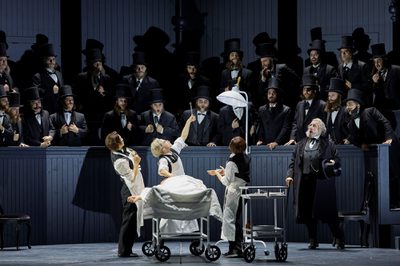
I would not claim it is the finest libretto. There are words that even I, as an Italian, have to look up in the dictionary... But the dramaturgy of the piece works magnificently! It is the heightened situations that make this opera so powerful – for example when Ulrica prophesies Riccardo's death, or when Renato discovers his wife's infidelity and immediately joins the conspirators. The linguistic details of the text are not what is decisive. Verdi did not always have the best librettists available. Congenial collaborations such as his later partnership with Arrigo Boito, or Mozart's earlier one with Da Ponte, are the great exceptions, not the rule...
But the protagonists of the piece are very finely drawn...
Absolutely. Verdi captured the three main characters in their psychological states with great precision: the often childlike, over-emotional but ultimately resolute Riccardo; his friend Renato, who in the third act is deeply wounded and yet – musically too – can never entirely conceal that he is at heart Riccardo's friend; and Amelia, who is at the mercy of these two men and feels simultaneously swept away and guilty. And with the light soprano Oscar and the contralto role of Ulrica, Verdi extends the spectrum of colours to the extremes in this respect too.
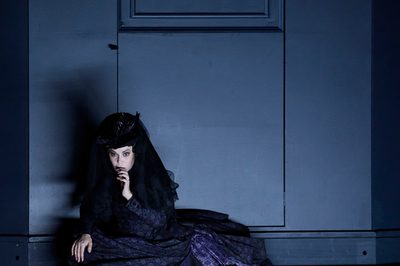
At the centre of the opera stands the great duet in which Amelia and Riccardo meet in secret and are discovered. This is a similar situation to the second act of Tristan und Isolde, which Richard Wagner was composing at roughly the same time...
But the two scenes are hardly comparable. Between Tristan and Isolde, love is explored in its full philosophical and metaphysical dimension. Verdi's dramatic love scene is far more instinctive and direct: it is about seduction, attraction, about all the subtleties of human emotional response. Perhaps somewhat similar to Wagner is the fact that Verdi's duet moves towards an absolutely ecstatic moment in which the full orchestra underlines the overwhelming force of this love. And of course both scenes take place at night and in secret. In that respect there are certain similarities.
What role does the chorus play in this opera?
The chorus has no great independent number as in the French Grand Opéra or in other Verdi operas. But that does not make it any less present or less important! The opera begins directly with the chorus – and Verdi introduces two groups there with great subtlety: on one side the supporters of Riccardo, and on the other those who belong to the conspirators Sam and Tom. The chorus is also present in the scene with Ulrica, embodying the crowd among whom Riccardo can mingle incognito. And of course in the third act the chorus forms – together with dancers and two stage orchestras – the great throng of the masked ball, from which the principal characters then emerge.
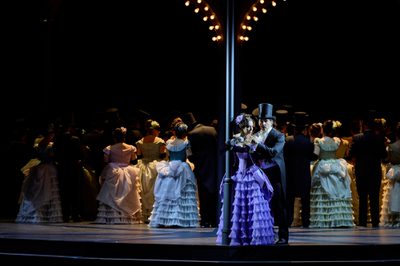
How does Verdi shape this masked ball?
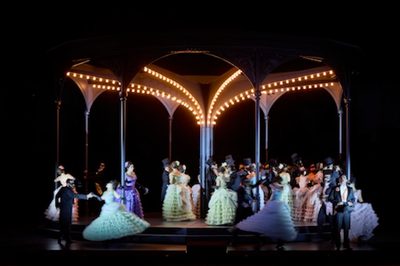
Verdi was a very fine composer of dance music. And that is of course also connected with his Parisian experiences. For Les Vêpres siciliennes he was required, in accordance with the conventions there, to write ballet interludes, as he later did for the Parisian productions of Macbeth and Otello. These are very fine compositions! In A Masked Ball however, the dance music is, like all elements in this opera, perfectly integrated into the overall dramaturgy. With its smooth elegance it once again forms a great contrast and a backdrop to what is actually taking place: the tragic murder of Riccardo. Alongside the uncanny, sombre music that Verdi writes for Ulrica or for the eerie, desolate location where the second act is set, there is in this final scene a hyper-elegant quality that smells of caviar, champagne and strawberries. Very perfumed...
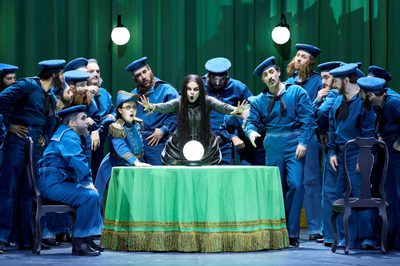
We are speaking at the sidelines of a rehearsal where you are working with the orchestra on Verdi's opera. What is the key to that process?
The orchestra is for me in almost every opera – except perhaps in bel canto – a character, a person. The orchestra sets the atmosphere, the underlying mood, from which all the actions that take place and are sung on stage first receive their motivation. Of course technical matters must also be addressed in these rehearsals. But what matters most to me is establishing a shared tone colour. The orchestration of A Masked Ball score is very delicate – think for example of the opening of the piece: the opera begins with plucked and almost whispered sounds, emerging from almost nothing. That is what we are working on at the moment. It is interesting with this piece: it sounds like Verdi, and yet one keeps asking oneself – where does this come from? The quality of the mask, of concealment, is felt in this piece right down into the music itself.