News Story
It is becoming increasingly difficult to decide where jazz starts or where it stops, where Tin Pan Alley begins and jazz ends, or even where the borderline lies between classical music and jazz. I feel there is no boundary line.Duke Ellington, 1956
Who was Duke Ellington?
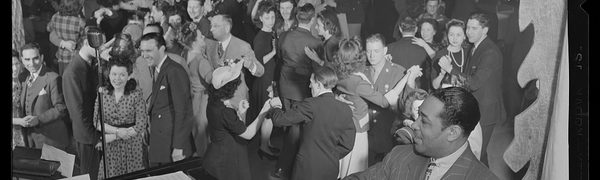
Born in 1899 in Washington, D.C., Ellington grew up in a musical household, the child of two pianists. He began piano lessons at seven, and by his early teenage years was already composing his own music by ear, with a focus on feel as opposed to form. He earned the nickname ‘Duke’ as a youngster, for being incredibly polite and dapper.
As a young musician, he made his way into the vibrant jazz scene of New York, landing a residency at the legendary Cotton Club in Harlem - a club that, due to segregation, he and his fellow Black musicians couldn’t enter through the front door. It was here, in the late 1920s, that Ellington and his orchestra began to define a sound that would shape the future of jazz and set the tone for the sound of the Swing Era.
The Legacy
As air travel expanded in the 1940s and 1950s, Duke Ellington’s big band became one of the first to tour extensively, bringing his music across the United States and around the world. Over the course of his five-decade career, Ellington wrote and collaborated on an estimated 2,000 or more compositions, defining an era and profoundly influencing generations of musicians.
His body of work represents the largest recorded personal legacy in jazz history, with many of his compositions becoming enduring jazz standards studied and performed worldwide. Ellington led the Duke Ellington Orchestra for more than 50 years, recording thousands of works with the ensemble
Black, Brown and Beige
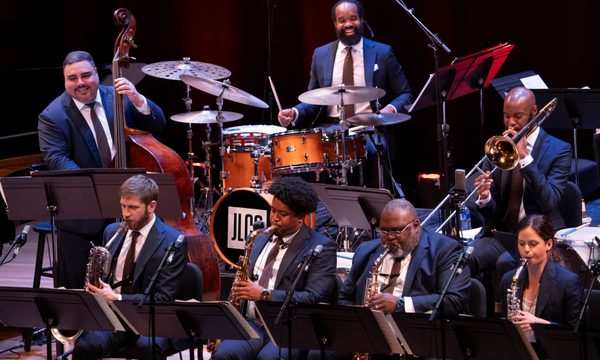
In August, the Jazz at Lincoln Center Orchestra with Wynton Marsalis will perform Duke Ellington’s Black, Brown and Beige symphony, an extended meditation on the Black experience in America, at the Edinburgh International Festival.
Written in 1943 for Ellington’s first appearance at Carnegie Hall, the work was conceived to present jazz as an art form equal to European classical music, especially in the eyes of white audiences. Through Black, Brown and Beige, Ellington articulated the lives of Black Americans within a cultural space from which they had historically been excluded.
The suite is structured in three large movements—Black, Brown, and Beige—each of which contains smaller internal sections. Together, these movements form a narrative that is greater than the sum of its parts, tracing Black history, identity, and aspiration within the broader American story.
Black
Black evokes a history of labour and suffering, marked by indomitable hope, quiet spirituality and a cry for understanding.
Brown
Brown turns toward the often-overlooked patriotism of Black Americans - the soldiers who fought in the Revolutionary and Civil Wars and received little gratitude from the nation they served.
Beige
Beige offers no happy ending. Instead, it reflects on modern life and the dreams of progress. Ellington acknowledges the distance travelled while remaining acutely aware of how far there was yet to go.
Duke Ellington and Wynton Marsalis
Duke’s legacy has lived on in the decades since his passing, rippling outward through generations of musicians. Nowhere is that more visible than in the work of Wynton Marsalis.
Marsalis has described Ellington as:
our Homer, who takes our mythology and puts it in a context so it can be re-created generation after generation.Wynton Marsalis
Through Marsalis’s leadership at Jazz at Lincoln Center, Ellington’s music has remained central — from Portraits by Ellington and Live in Swing City to Handful of Keys, Black, Brown & Beige, and the long running Essentially Ellington series. In engaging the music of Ellington, Marsalis adds new historical meaning to Ellington’s artistic impact and reinforces the enduring cultural relevance of his work to this day.
Experience Duke Ellington's Black, Brown and Beige, performed by Jazz at Lincoln Center Orchestra with Wynton Marsalis on Tue 11 Aug 2026, 7.30pm at Usher Hall.