News Story
Samuel Coleridge-Taylor found huge success with The Song of Hiawatha, a work rooted in a version of Indigenous identity shaped entirely from the outside. Join Uchenna Ngwe as she dives into the history – and contemporary complexities – of this epic work.
Orchestre symphonique de Montréal perform Coleridge-Taylor’s The Song of Hiawatha on Wed 19 Aug 2026, 7.00pm at Usher Hall.

Written by Uchenna Ngwe
Dr Uchenna Ngwe is an oboist, composer, and researcher. She created plainsightSOUND – an online research project investigating historical Black British classical musicians – and is a regular contributor to arts programmes, including the BBC Radio 3 Sunday Feature The Hiawatha Phenomenon.
Read time: 3-4 minutes
The Song of Hiawatha: Searching for Authenticity
Samuel Coleridge-Taylor's epic trio of cantatas, Scenes from 'The Song of Hiawatha' Op.30, is arguably one of the composer's most well-known musical works. At the height of its popularity in the early 20th century, crowds of concertgoers attended fully-staged performances at the Royal Albert Hall.
Even as the rest of his repertoire fell out of fashion, this was the piece that people all over Britain were familiar with for decades after his death. Despite being based on a famous poem by Anglo-American poet Henry Wadsworth Longfellow, it was seen as a true representation of Native American culture. But for audiences today, this raises questions about many of the assumptions threaded through Western art and culture of this period.
Talent, Prejudice and Patronage
The impact of Coleridge-Taylor's identity as a man of mixed European and African descent runs through many of his compositions. This was London in the late 19th-century, and English music was finally shedding its reputation for poor musicianship. By the time he graduated from the Royal College of Music, Coleridge-Taylor was already being touted as one of its earliest and greatest success stories.
This didn't protect him from the open racial prejudice and persecution he faced during his time there, but he had gained respect and supporters from more established musicians. Charles Villiers Stanford, who taught him at the Royal College of Music, remained a musical mentor through his career, reportedly defending him from racial slurs. Coleridge-Taylor was also championed early on by Edward Elgar whose own large choral work Dream of Gerontius from 1900 has since been compared – in stature at least – to Coleridge-Taylor's piece.
Encouraged by Stanford, Coleridge-Taylor began composing Hiawatha's Wedding Feast as the first part of this trilogy in 1897. It premiered in 1898 with Stanford conducting. He completed the rest over the next two years and the first complete performance of The Song of Hiawatha took place in 1900 at the Royal Albert Hall.
With this work, he established himself as a serious composer and conductor to be reckoned with.
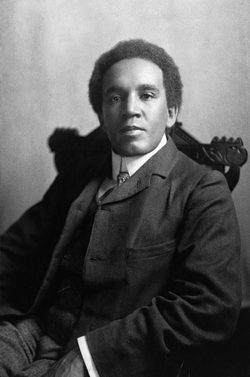
Samuel Coleridge Taylor
© WikicommsThe Sources Behind the Setting
A combination of Coleridge-Taylor's mixed heritage and his interest in non-Western cultures has led many people to assume that his approach to Hiawatha and the cultural depictions it contains must be authentic. Titles of several of his other pieces including African Romances op. 10 (based on the poems of Paul Laurence Dunbar), African Suite Op. 35, and Twenty-Four Negro Melodies, Op. 59 highlight an exploration of his heritage that ran through his music. He was inspired by the sounds from the expanding world around him.
From Brahms, Grieg and Dvorak, to 'African' or 'Moorish' music collected and by missionaries, to African American spirituals taught to him by the famous Fisk Jubilee Singers while touring Europe, Coleridge-Taylor's compositions reflected his search for connection. This was the height of the British Empire, and Coleridge-Taylor existed at the intersection of all of this. For him, Henry Wadsworth Longfellow's reimagining of a Native American story connected him to a character who was also an outsider. But, in Victorian England, how realistic were Coleridge-Taylor's cultural sources, particularly when it came to Hiawatha?
Hiawatha appears as a figure in Iriquoi culture, but Longfellow merged several different sources – including Henry Rowe Schoolcraft, who invented aspects of his writing. 19th-century readers were developing a single broad impression of Native American culture.
As Longfellow's poem became popular, Wild West shows were touring Europe and the Americas with Native American performers encouraged to re-enact historical trauma and defeats. These stories led directly to the tropes of the Noble Savage and 'dying culture' that is still seen consistently in film and TV Westerns, popular culture, fashions and product advertising.
The popularity of both Longfellow's original poem and Coleridge-Taylor's setting extended far beyond either of their lives. Until the mid-20th century, the poem was regularly taught in British school curriculums and children sang the music in smaller-scale school productions.
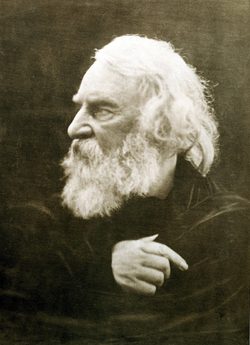
Henry Wadsworth Longfellow photographed by Julia Margaret Cameron in 1868
© WikicommsFacing a Complicated Legacy
Today, we are more aware of the problematic origins of The Song of Hiawatha. This increases the challenges of performing it but can lead us to new ways of approaching any music. Ojibwe scholar Anton Treuer has spoken about the importance of literary and musical exploration and how engagement with other cultures can be 'an opportunity to examine our shared humanity'.
This doesn't mean that we should ignore the deep harm of stereotypes and racial prejudice, or that we should pretend things haven't happened in the past. We need to face them head on. Instead, this is a chance for us to understand the impact of a complex history and to be more curious about how our present might be depicted in the future.
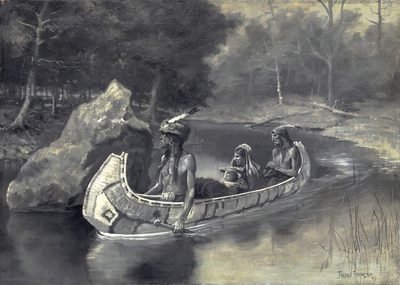
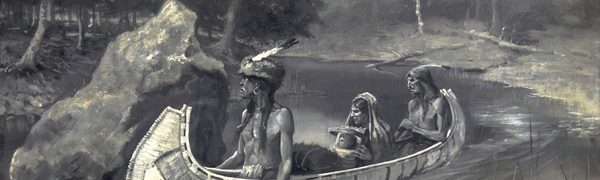
An illustration by Frederic Remington for Longfellow's poem The Song of Hiawatha c1888
© Wikicomms