News Story
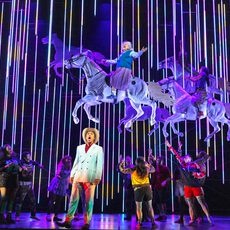
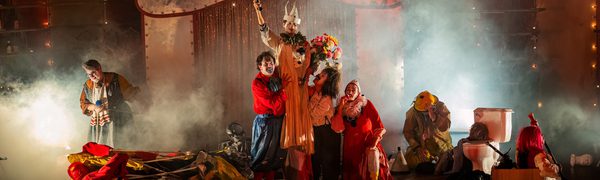
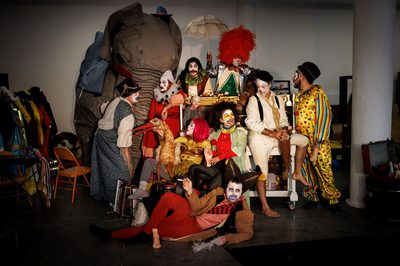
Clown Show, Geoff Sobelle’s latest work, presents America as a disintegrating circus: all the other performers have long abandoned the big top and only the clowns remain. The implications for contemporary America are clear – with the clowns left in charge, how long will it take America to head towards catastrophe and disaster?
Clown Show runs Thu 27 – Sun 30 Aug 2026 at The King's Theatre.

Written by Louise Peacock
Louise Peacock is Associate Professor of Drama in the School of Arts, Design and Humanities at De Montfort University, UK. She is the author of Serious Play: Modern Clown Performance (2009) and Slapstick and Comic Performance: Comedy and Pain (2014).
Read time: 6 minutes
The Fool’s Privilege: Speaking Truth through Laughter
Clown Show, Geoff Sobelle’s latest work, presents America as a disintegrating circus: all the other performers have long abandoned the big top and only the clowns remain. The implications for contemporary America are clear – with the clowns left in charge, how long will it take America to head towards catastrophe and disaster?
Sobelle calls himself a 'dedicated absurdist', his work often using surrealism and poetic imagery to reveal truths about humanity and contemporary society. In using clowning to lay those truths bare, Sobelle is part of a long tradition.
Clown Show
© Maria Baranova-SuzukiSpeaking Truth from the Margins of Power
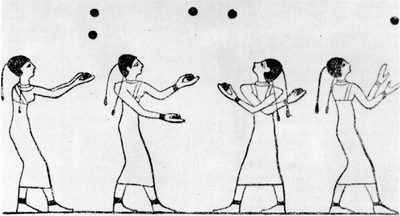
Early jesters existed as far back as the 25th century BCE in Ancient Egypt, but today we tend to be more familiar with the court jesters of medieval Europe. Jesters may have primarily served their rulers while operating within the limits of sanctioned entertainment – but their licensed foolishness may also have provided opportunities for political critique and social commentary in a way which was transgressive.
Protected by their status as fools, these colourful characters could draw attention to matters of state, expose hypocrisy, and generally say things that would have been incredibly risky for others to say. Their performed foolishness, and their position on the margins of society, perhaps provided some license to call out their rulers and to challenge their actions and decisions.
Clowns - with their outlandish hair, makeup, costume and behaviour - can act as a corrective to the vanity and pretensions of authority. By exposing contradictions, mocking excesses, and drawing attention to social and political failings, clowns can offer a form of critique that challenges those in power while remaining publicly acceptable. In this sense, the fool, jester, or clown performs a role similar to the carnivalesque.
During carnival we see a temporary inversion of social hierarchies and norms: unacceptable behaviour becomes briefly acceptable, allowing ordinary people to mock authority and imagine alternative ways of organising society. Established hierarchies can be questioned and hidden truths revealed – just as Sobelle's clowns are questioning, in their own way, the current American leadership.
Clowning as resistance
Despite the value of this truth-telling role, the clown or jester has not always occupied a central position in society. They pop up when autocrats and dictators are in power and when ordinary people might be afraid to voice opposition.
During the nineteenth and twentieth centuries political clowning appeared only intermittently in cabaret, circus performance, and film. Nevertheless, where political clowning did emerge, it retained the historic function of the fool: using humour, satire, and apparent absurdity to reveal truths that more conventional forms of speech could not easily express.
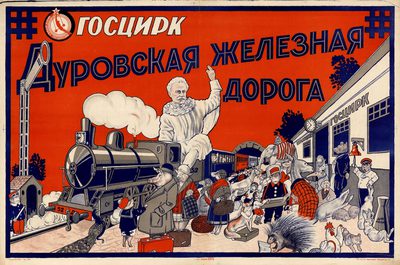
The Russian circus clown Vladimir Durov was often advertised as a satirist and political clown, but his work moved beyond sanctioned transgression into territory that got him into serious trouble. One routine, performed in Berlin, involved a trained pig retrieving a German officer's helmet while Durov used ventriloquism to imply that the animal was calling itself Wilhelm, thus equating Kaiser Wilhelm II to a pig.
By symbolically reducing one of Europe's most powerful political figures to a trained pig, Durov used clowning to expose and ridicule authority. His subsequent arrest demonstrates that political clowning could carry real consequences when its truths became too direct or threatening.
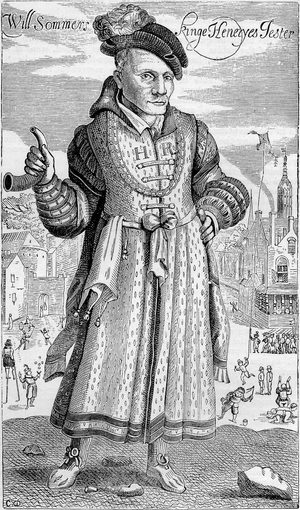
An engraving by Francis Delaram c 1615 24 Will Sommers was Henry VII Is famous fool
© Wikimedia CommonsClowning as resistance: Charlie Chaplin
Similar risks accompanied political clowning in the twentieth century. Charlie Chaplin's film The Great Dictator (1940) used clown behaviour to challenge fascism at a time when such criticism remained controversial in isolationist America.
Playing both the Jewish barber and the dictator Adenoid Hynkel, Chaplin used clowning to invert power and expose authority as inherently absurd.
The climax of the film places the truth-telling clown in the position of the dictator. Mistaken for Hynkel, the barber addresses the nation and delivers Chaplin's authentic plea for humanity, democracy, and liberty. Once again, the clown assumes the traditional role of the fool speaking truths that others are unwilling to voice.
Chaplin was later excluded from the United States because of suspicions surrounding his political views, showing that even as late as the 20th century, clowning could carry genuine personal and professional risks.
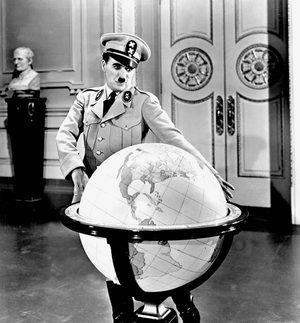
Charlie Chaplin in The Great Dictator
© Wikimedia CommonsThe Power of Clowns
In contemporary society, much of this truth-telling function has passed to stand-up comedians – but a troupe of clowns can do far more than a solo performer and engage an audience much more physically.
In the UK, Robyn Hambrook delivers clown activist training drawing on the clown’s ability to confuse rather than confront; to parody and mock authority and to use both failure and play as political acts. Using these kinds of tactics, clowns have caused road closures and other kinds of mayhem. This brand of activism honestly and authentically reconnects with the clown transgression of earlier centuries. Sobelle’s Clown Show does the same thing.
The carefully made-up clowns with their shocks of wild hair reconnect with the truly transgressive and truth-telling power of clown to stand outside acceptable behaviour, using parody and play to draw attention to the significant issues facing contemporary America. The clowns are all that is left – and they're trying to make the best of an America that is falling apart.